
Published: December 15, 2025
Author: Technical Philosophy Series
Reading Time: 12 minutes
Tags: Programming Philosophy, Software Engineering, Abstraction, Computer Science Theory
Introduction: The Illusion of Code
Every morning, millions of programmers around the world sit down at their computers, open their IDEs, and begin typing. Lines of code flow across screens—functions, classes, variables, loops. To the untrained eye, this is programming. But what if I told you that programming was never really about code at all?
What if the essence of programming lies not in the syntax we write, but in something far more fundamental—something that has remained constant since the first human drew symbols in the sand to represent abstract concepts?
This is the story of abstraction’s eternal return, and why understanding this principle will make you not just a better programmer, but a better thinker.
The First Abstraction: From Cave Paintings to Algorithms
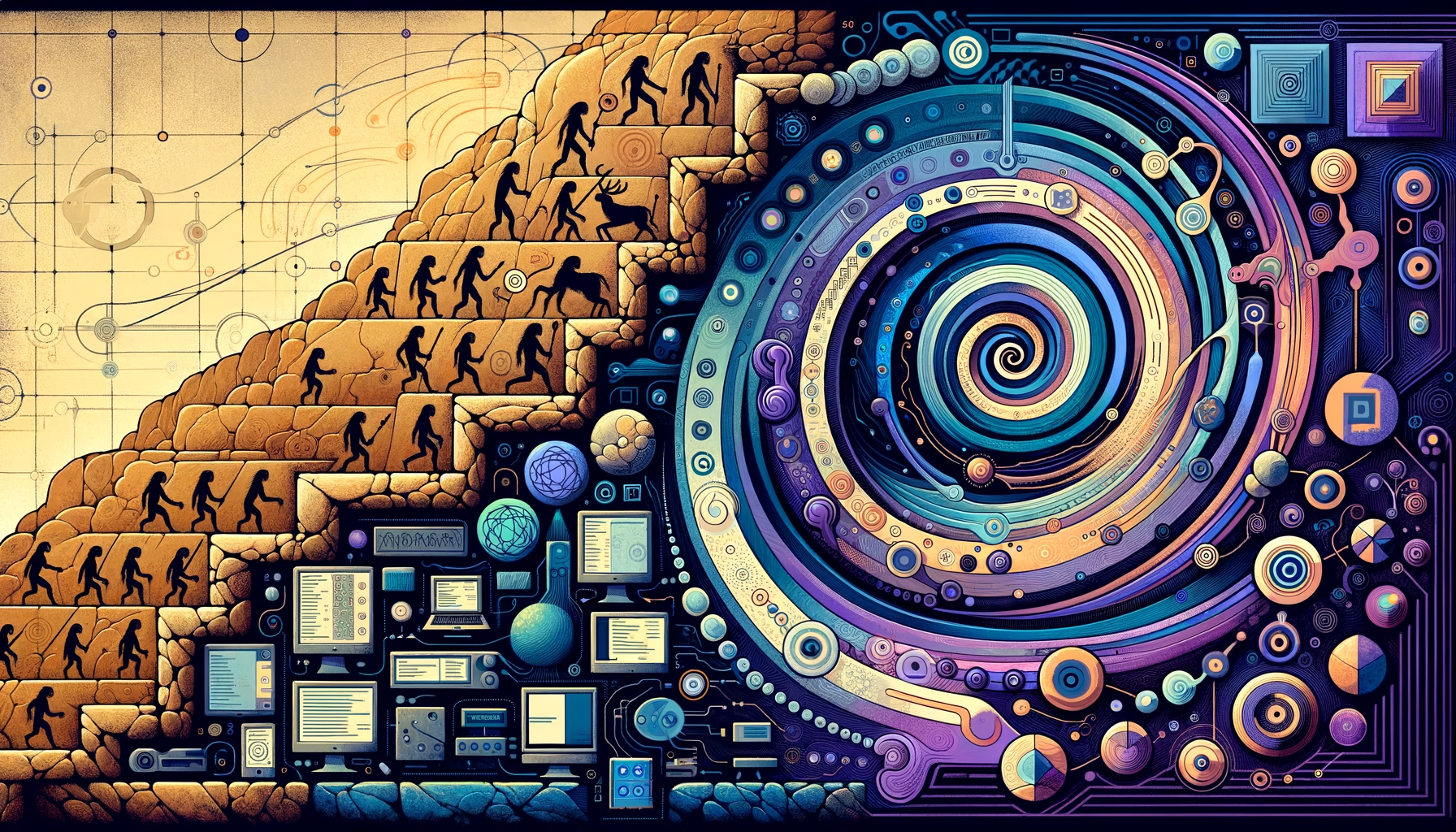
Long before the first computer was built, humans were already programming. When our ancestors drew a bison on a cave wall, they weren’t just creating art—they were creating the first user interface, the first abstraction layer between complex reality and human understanding.
That cave painting was a program. It took the infinite complexity of a living, breathing, moving bison and reduced it to essential elements: four legs, horns, a body. It was lossy compression at its finest, preserving only what mattered for the intended purpose—communication, memory, perhaps ritual.
Fast forward 40,000 years, and we’re still doing the same thing. When you write:
class User {
    private String name;
    private String email;

    public void sendNotification(String message) {
        // Implementation details hidden
    }
}
You’re not really writing code. You’re drawing a cave painting of a user—reducing the infinite complexity of a human being to just the attributes and behaviors that matter for your system. The code is just the medium, like ochre on stone.
The Abstraction Stack: Turtles All the Way Down
Consider the layers of abstraction in a simple “Hello, World!” program:
- Your code:
print("Hello, World!") - Language runtime: Interprets your high-level command
- Operating system: Manages system calls and resources
- Hardware abstraction layer: Translates to machine instructions
- Processor: Executes binary operations
- Transistors: Switch electrical states
- Quantum mechanics: Electrons behave according to physical laws
Each layer hides the complexity of the layer below. Your “Hello, World!” is really a symphony of billions of quantum events, but you don’t need to think about electron spin to write useful software. This is the power—and the eternal return—of abstraction.
The Philosophy of Computational Thinking
Programming languages come and go. COBOL, FORTRAN, C, Java, Python, Rust—each generation believes their language is the future, the final answer. But languages are just notation systems, like musical notation or mathematical symbols. The music exists independently of how it’s written down.
What remains constant is computational thinking—the ability to:
- Decompose complex problems into manageable parts
- Recognize patterns across different domains
- Abstract away irrelevant details
- Design algorithms that solve classes of problems
These skills predate computers by millennia. Ancient mathematicians used them to prove theorems. Medieval scholars used them to organize knowledge. Renaissance artists used them to create perspective. We’re not teaching people to code—we’re teaching them to think like the universe itself thinks.
The Platonic Realm of Algorithms
Plato argued that mathematical objects exist in a perfect realm beyond physical reality. A circle drawn in sand is just a shadow of the perfect Circle that exists in the realm of Forms. Similarly, every implementation of quicksort—whether written in C, Python, or carved in stone—is just a shadow of the perfect Quicksort algorithm that exists in the realm of computational Forms.
This is why a programmer can look at pseudocode and immediately understand it, regardless of their preferred language:
function quicksort(array):
    if length(array) ≤ 1:
        return array

    pivot = choose_pivot(array)
    less = [x for x in array if x < pivot]
    equal = [x for x in array if x = pivot]
    greater = [x for x in array if x > pivot]

    return quicksort(less) + equal + quicksort(greater)
The algorithm exists independently of its expression. Code is just one way to manifest these eternal computational truths.
The Great Abstractions: A Historical Perspective
Throughout computing history, progress has been marked not by faster processors or more memory, but by better abstractions. Each breakthrough allowed us to think at a higher level, to solve bigger problems by ignoring lower-level details.
The Assembly Language Revolution
In the beginning, programmers worked directly with machine code—pure binary. Then came assembly language, which gave names to operations:
; Machine code (binary)
10110000 01100001

; Assembly language
MOV AL, 61h
This simple abstraction—giving names to numbers—revolutionized programming. Suddenly, humans could think in terms of “move” and “add” instead of memorizing binary patterns.
The High-Level Language Explosion
FORTRAN (1957) introduced mathematical expressions. Instead of:
LOAD A
ADD B
STORE C
Programmers could write:
C = A + BThis abstraction allowed scientists and engineers to focus on their domain problems rather than computer architecture. The eternal return of abstraction had claimed another victory.
The Object-Oriented Paradigm
Object-oriented programming wasn’t really about objects—it was about organizing complexity. It gave us new abstractions:
- Encapsulation: Hide implementation details
- Inheritance: Reuse and extend existing abstractions
- Polymorphism: Treat different things the same way
These weren’t just programming techniques—they were ways of thinking about the world. A “Vehicle” class doesn’t exist in nature, but it’s a useful abstraction that helps us reason about cars, trucks, and motorcycles.
The Modern Era: Frameworks and Platforms
Today’s abstractions are even more powerful. Consider this React component:
function UserProfile({ user }) {
    return (
        <div className="profile">
            <h1>{user.name}</h1>
            <p>{user.email}</p>
        </div>
    );
}
Behind this simple function lies an entire universe of complexity: virtual DOM diffing, event handling, browser compatibility layers, HTTP protocols, TCP/IP stacks, and ultimately, quantum mechanics. But the programmer doesn’t need to think about any of that. They can focus on the user experience, the business logic, the human problems they’re trying to solve.
The Paradox of Abstraction
Here’s the beautiful paradox: the more we abstract away from the machine, the more human our programs become. The closer we get to natural language, the more we can express complex ideas.
Compare these equivalent programs:
// Low-level C
int sum = 0;
for(int i = 0; i < n; i++) {
    sum += array[i];
}

// High-level Python
sum(numbers)

// Natural language
"Add up all the numbers"
The progression is clear: we're moving from machine-centric to human-centric expression. The ultimate abstraction would be pure thought—and we're getting closer to that every day with AI-assisted programming.
The Leaky Abstraction Problem
But abstractions are never perfect. Joel Spolsky's "Law of Leaky Abstractions" reminds us that all non-trivial abstractions leak. You can write high-level code all day, but eventually you'll hit a performance problem that requires understanding the layers below.
This isn't a bug—it's a feature. The best programmers understand multiple levels of abstraction and can move fluidly between them. They can think in terms of user stories and business logic, but also understand memory management and algorithmic complexity when needed.
Programming as Language Evolution
Programming languages evolve like natural languages. They start simple and grow complex as they adapt to new needs. But unlike natural languages, programming languages can be designed—they're conscious attempts to create better abstractions for human thought.
Consider how we express the same concept across different paradigms:
// Imperative: How to do it
numbers = [1, 2, 3, 4, 5]
result = []
for num in numbers:
    if num % 2 == 0:
        result.append(num * 2)

// Functional: What to do
numbers.filter(n => n % 2 === 0).map(n => n * 2)

// Declarative: What we want
SELECT num * 2 FROM numbers WHERE num % 2 = 0
Each paradigm offers a different lens for viewing the same problem. The imperative approach focuses on control flow. The functional approach emphasizes transformation. The declarative approach describes the desired outcome. None is inherently better—they're different tools for different kinds of thinking.
The Sapir-Whorf Hypothesis of Programming
The Sapir-Whorf hypothesis suggests that language shapes thought. If this is true for natural languages, it's certainly true for programming languages. A programmer who thinks in Lisp sees the world as nested functions and recursive structures. A programmer who thinks in Haskell sees pure functions and immutable data. A programmer who thinks in Prolog sees logical relationships and constraint satisfaction.
This is why learning new programming paradigms is so valuable—not because you'll use them directly, but because they give you new ways to think about problems. Each language is a different abstraction over the same computational substrate.
The Future of Abstraction
Where is abstraction heading? The trends are clear:
Natural Language Programming
AI tools like GitHub Copilot and GPT-4 are already allowing programmers to express intent in natural language and get working code. This isn't the end of programming—it's the next level of abstraction. Instead of thinking in terms of loops and conditionals, we can think in terms of goals and constraints.
// Today
function validateEmail(email) {
    const regex = /^[^\s@]+@[^\s@]+\.[^\s@]+$/;
    return regex.test(email);
}

// Tomorrow
"Create a function that validates email addresses"
Visual Programming
Tools like Scratch, Unreal Engine's Blueprint system, and various no-code platforms are making programming more visual and intuitive. This isn't "dumbing down" programming—it's making the abstractions more accessible to human cognition.
Domain-Specific Languages
We're seeing an explosion of DSLs—languages designed for specific problem domains. SQL for databases, CSS for styling, regex for pattern matching, Terraform for infrastructure. Each DSL is a perfect abstraction for its domain, allowing experts to express complex ideas concisely.
The Eternal Return: Why This Matters
Nietzsche's concept of eternal return suggests that all events recur infinitely. In programming, we see this pattern constantly: the same fundamental problems being solved at higher and higher levels of abstraction.
Memory management returns as garbage collection, then as automatic memory management, then as managed runtimes. Concurrency returns as threads, then as async/await, then as actor models. Data storage returns as files, then as databases, then as ORMs, then as cloud services.
Each iteration solves the same core problems but at a higher level of abstraction, making the solutions accessible to more people and applicable to bigger problems.
The Democratization of Programming
This eternal return of abstraction has a profound effect: it democratizes programming. What once required deep technical knowledge becomes accessible to domain experts. Scientists can analyze data without learning C++. Designers can create interactive experiences without understanding JavaScript engines. Business analysts can automate workflows without writing assembly code.
This isn't the death of programming—it's programming's greatest triumph. We've created abstractions so powerful that the underlying complexity becomes invisible, allowing human creativity to flourish at higher levels.
Practical Implications: How to Think Like an Abstraction Master
Understanding that programming is fundamentally about abstraction changes how you approach problems:
1. Focus on the Problem, Not the Solution
Before writing any code, spend time understanding the problem domain. What are the essential concepts? What are the relationships between them? What can be safely ignored? The best abstractions emerge from deep domain understanding.
2. Learn Multiple Paradigms
Don't just learn languages—learn ways of thinking. Study functional programming even if you work in Java. Understand logic programming even if you never use Prolog. Each paradigm gives you new abstraction tools.
3. Build Your Own Abstractions
The most powerful programmers don't just use existing abstractions—they create new ones. Write libraries, design APIs, create domain-specific languages. Each abstraction you build makes you better at recognizing patterns and simplifying complexity.
4. Understand the Layers Below
Good abstractions hide complexity, but great programmers understand what's being hidden. Learn how your high-level code translates to lower levels. This knowledge helps you debug problems, optimize performance, and design better abstractions.
5. Embrace the Eternal Return
Recognize that today's cutting-edge solution will become tomorrow's legacy system. Design with future abstraction in mind. Make your code modular, your interfaces clean, your concepts clear. The next generation of programmers will build on your abstractions.
Conclusion: The Code Beyond Code
Programming was never about code. It was always about thought—about taking the infinite complexity of the world and finding ways to represent, manipulate, and reason about it using finite symbols and rules.
The cave painter who drew a bison was programming. The mathematician who invented algebra was programming. The architect who designed blueprints was programming. They were all creating abstractions—simplified models that captured essential truths while hiding irrelevant details.
Today's programmers are part of this ancient tradition. We're not just writing software—we're extending human cognition, creating new ways to think about and interact with reality. Every function we write, every class we design, every API we create is another step in humanity's ongoing project to understand and shape the world through abstraction.
The eternal return of abstraction continues. Each generation of programmers builds on the work of the previous generation, creating higher-level abstractions that make the impossible possible. We stand on the shoulders of giants—not just the famous computer scientists, but every human who ever created a symbol to represent an idea.
So the next time you sit down to write code, remember: you're not just typing characters into a text editor. You're participating in the most fundamental human activity—the creation of meaning through abstraction. You're continuing a conversation that began in caves and will continue until the last human draws the last symbol.
Programming was never about code. It was always about us.
Further Reading
- "The Structure and Interpretation of Computer Programs" by Abelson and Sussman - The classic text on computational thinking
- "Out of the Tar Pit" by Moseley and Marks - On complexity and abstraction in software systems
- "The Art of Computer Programming" by Donald Knuth - The mathematical foundations of algorithms
- "Gödel, Escher, Bach" by Douglas Hofstadter - On consciousness, recursion, and self-reference
- "The Pragmatic Programmer" by Hunt and Thomas - Practical wisdom on software abstraction
What abstractions have shaped your thinking as a programmer? How do you see the eternal return of abstraction playing out in your own work? Share your thoughts and experiences in the comments below.