Published: November 26, 2025
Author: Afjal Ahamad, Senior Data Engineer
Reading Time: 8 minutes
Tags: AWS, AI, Business Intelligence, Data Analytics, Quick Suite, Enterprise AI
Introduction: A New Era of Data Intelligence
Imagine asking your data a question in plain English and getting an instant, comprehensive answer—complete with visualizations, insights, and actionable recommendations. No SQL queries. No waiting for the data team. No switching between multiple applications.
This isn’t science fiction. It’s AWS Quick Suite, and it’s transforming how organizations interact with their data.
Launched in October 2025, AWS Quick Suite represents Amazon’s bold vision for the future of business intelligence: a unified, AI-powered platform that combines research, analytics, and automation into a single, conversational workspace. After spending weeks exploring this platform, I’m convinced it’s not just another BI tool—it’s a fundamental shift in how we think about data-driven decision-making.
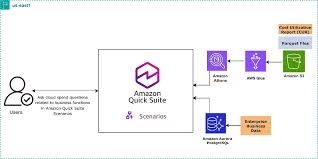
The Problem: Data Silos and Decision Paralysis
Let’s be honest: most organizations are drowning in data but starving for insights.
The typical data analyst’s day looks something like this:
- Open Excel to check yesterday’s sales numbers
- Switch to Tableau to build a dashboard
- Jump into SQL Workbench to query the data warehouse
- Export results to PowerPoint for the executive team
- Repeat this process for every single question
The result?
- 40% of productive time lost to context switching
- Days or weeks to answer simple business questions
- Data teams overwhelmed with requests
- Business users frustrated by delays
- Critical decisions made on gut feeling instead of data
I’ve seen this pattern across retail, finance, healthcare, and manufacturing. The tools are powerful, but they’re fragmented. The data is abundant, but it’s inaccessible. The insights are valuable, but they arrive too late.
AWS Quick Suite aims to solve all of this.
What is AWS Quick Suite?
AWS Quick Suite is a unified, AI-powered platform that brings together:
🔍 Quick Research – Your AI Research Analyst
Think of it as having a tireless research analyst who can synthesize information from thousands of sources in minutes. Ask it to analyze market trends, competitive positioning, or customer behavior, and it generates comprehensive reports with verified sources and actionable recommendations.
Real-world example: Instead of spending 2-3 weeks manually analyzing customer feedback, product reviews, and support tickets, Quick Research can synthesize insights across all these sources in 15 minutes.
📊 Quick Sight – Conversational Business Intelligence
This isn’t your grandfather’s BI tool. Quick Sight lets you ask questions like:
- “Show me our top 10 products by profit margin this quarter”
- “Compare sales performance across regions for the last 6 months”
- “What’s driving the increase in customer churn?”
And it doesn’t just show you charts—it explains what’s happening and why it matters.
🤖 Quick Automate & Flows – Intelligent Automation
From simple workflows to complex, multi-step business processes, Quick Suite can automate it. The best part? Business users can create these automations using natural language—no coding required.
Example: “Every Monday morning, analyze last week’s inventory levels, identify products below reorder point, and send alerts to the procurement team.”
Done. Automated. Forever.
💬 Chat Agents – Specialized AI Assistants
Create custom AI agents tailored to specific business functions. A sales agent that knows your product catalog. A compliance agent that understands your regulatory requirements. A customer service agent that can access order history and resolve issues.
These aren’t chatbots—they’re intelligent assistants that can reason, analyze, and take action.
🗂️ Quick Index – The Knowledge Foundation
Behind the scenes, Quick Index creates a unified, searchable repository of all your enterprise data—databases, documents, emails, spreadsheets, everything. It’s the foundation that makes all the other capabilities possible.
Why Quick Suite is Different: The Agentic AI Advantage
Here’s what sets Quick Suite apart from traditional BI tools: agentic AI.
Traditional BI tools are passive. They show you what happened. You still have to figure out what to do about it.
Quick Suite is active. It doesn’t just identify that inventory is low—it can automatically adjust pricing, notify suppliers, update your e-commerce site, and create purchase orders. All within the guardrails you define.
This is the difference between business intelligence and business action.
The Power of Natural Language
I recently watched a merchandising manager with zero SQL knowledge ask Quick Suite:
“Which products in our winter collection have the highest return rates, and what are customers saying in their reviews?”
Within seconds, Quick Suite:
- Queried the returns database
- Analyzed customer review sentiment
- Correlated returns with specific product attributes
- Generated a report with recommendations
- Created a Jira ticket for the product team
Total time: 45 seconds.
The same analysis would have taken our data team 2-3 days.
Real-World Use Cases: Where Quick Suite Shines
1. Retail: Dynamic Pricing at Scale
A specialty retailer I worked with manages 15,000+ SKUs across extended size ranges. Manually monitoring inventory and adjusting prices was impossible—decisions lagged reality by 3-5 days.
With Quick Suite, they built an autonomous workflow that:
- Monitors inventory levels in real-time
- Detects demand spikes or slow-moving stock
- Calculates optimal pricing adjustments
- Updates prices across all channels
- Notifies the merchandising team
Result: 35% reduction in stockouts, 20% improvement in inventory turnover, $280K annual value.
2. Healthcare: Accelerated Research Analysis
A healthcare analytics team was spending weeks analyzing patient outcome data for clinical studies. Quick Research now synthesizes findings from electronic health records, clinical notes, and research literature in hours instead of weeks.
Result: 90% reduction in analysis time, faster insights for clinical decision-making.
3. Manufacturing: Predictive Maintenance
A manufacturing company uses Quick Suite to analyze sensor data from production equipment. When anomalies are detected, Quick Automate creates maintenance tickets, orders parts, and schedules technicians—all automatically.
Result: 40% reduction in unplanned downtime, $500K annual savings.
4. Financial Services: Compliance Automation
A financial services firm uses Quick Research to monitor regulatory changes across multiple jurisdictions. When new regulations are published, it automatically analyzes impact, generates compliance reports, and creates action items for the legal team.
Result: 75% faster compliance response, reduced regulatory risk.
The Technical Architecture: Built for Enterprise
As a data engineer, I appreciate that Quick Suite isn’t just powerful—it’s also well-architected.
Security First
- Runs entirely in your AWS account (no data leaves your environment)
- IAM-based access control
- Encryption at rest and in transit
- Full audit trails for compliance
- SOC 2, ISO 27001, HIPAA, PCI-DSS certified
Seamless Integration
Quick Suite connects to 40+ data sources out of the box:
- Data Warehouses: Redshift, Snowflake, BigQuery
- Databases: PostgreSQL, MySQL, SQL Server, Oracle
- Cloud Storage: S3, Azure Blob, Google Cloud Storage
- SaaS Applications: Salesforce, Jira, ServiceNow, Zendesk
- Collaboration Tools: Slack, Teams, Email
Scalable Architecture
Built on AWS’s proven infrastructure:
- AWS Bedrock for large language models
- SageMaker for specialized ML models
- Lambda for event-driven automation
- EventBridge for workflow orchestration
The ROI Story: Numbers That Matter
Let’s talk about the elephant in the room: cost.
Quick Suite isn’t free. For a 50-user deployment with typical usage, expect around $100K-150K annually.
But here’s the thing—the ROI is compelling:
Time Savings
- Manual reporting: 36 hours/week → 5 hours/week (86% reduction)
- Data analysis: 2-3 weeks → 15 minutes (98% reduction)
- Decision latency: 3-5 days → <1 hour (95% reduction)
Cost Savings
- Eliminate redundant BI tool licenses
- Reduce data team bottlenecks
- Optimize pricing and inventory decisions
- Decrease operational inefficiencies
Revenue Impact
- Faster response to market trends
- Better customer experiences
- Improved product development cycles
- Captured opportunities that would have been missed
Real example: A mid-sized retailer calculated 405% Year 1 ROI with a 2.2-month payback period. Even with conservative estimates (70% benefit realization), they still achieved 283% ROI.
Getting Started: A Practical Roadmap
If you’re considering Quick Suite, here’s my recommended approach:
Phase 1: Proof of Concept (1-2 weeks)
- Set up a sandbox environment
- Connect 2-3 key data sources
- Build 1-2 use cases
- Demonstrate value to stakeholders
Investment: Minimal (30-day free trial available)
Phase 2: Pilot (4 weeks)
- Deploy to 10-15 users
- Focus on high-impact use cases
- Measure success metrics
- Gather user feedback
Investment: ~$10K-15K
Phase 3: Full Rollout (12 weeks)
- Scale to entire organization
- Implement advanced use cases
- Integrate with existing systems
- Train users and establish best practices
Investment: $100K-250K (depending on scale)
Key Success Factors
- Executive sponsorship – This is a transformation, not just a tool
- Start with pain points – Focus on problems people feel daily
- Quick wins – Demonstrate value in the first 30 days
- User champions – Identify power users who can evangelize
- Continuous improvement – Iterate based on feedback
Challenges and Considerations
Let’s be realistic—Quick Suite isn’t perfect for everyone.
When Quick Suite Makes Sense:
- ✅ You have data scattered across multiple systems
- ✅ Your data team is overwhelmed with requests
- ✅ Decision-making is slow due to data access issues
- ✅ You’re already on AWS (or willing to be)
- ✅ You need to democratize data access
- ✅ You want to automate repetitive analytical tasks
When to Think Twice:
- ❌ You have simple BI needs (a basic dashboard tool might suffice)
- ❌ Your data quality is poor (fix that first)
- ❌ You’re not ready for AI-driven decisions
- ❌ Your organization resists change
- ❌ You need highly specialized industry-specific features
Common Concerns:
“Will AI make mistakes?”
Yes, sometimes. That’s why Quick Suite includes human-in-the-loop controls for critical decisions. You define the guardrails.
“What about our existing BI investments?”
Quick Suite can complement existing tools or replace them. Many organizations do a phased transition.
“Is our team ready for this?”
The beauty of natural language interfaces is that they’re intuitive. Most users are productive within days, not months.
The Future: Where This is Heading
AWS Quick Suite is just the beginning. Here’s what I see coming:
Near-term (2026):
- Enhanced predictive analytics
- Deeper integration with Microsoft 365
- Industry-specific templates and agents
- Advanced ML model integration
- Expanded language support (20+ languages)
Long-term Vision:
- Fully autonomous business operations
- AI-driven strategic planning
- Real-time market adaptation
- Predictive decision-making
- Self-optimizing business processes
We’re moving toward a world where data doesn’t just inform decisions—it makes them (within human-defined boundaries).
My Take: Is Quick Suite Worth It?
After extensive hands-on experience, here’s my honest assessment:
For large enterprises with complex data landscapes: Absolutely. The ROI is clear, and the competitive advantage is real.
For mid-sized companies ready to scale: Yes, if you’re hitting the limits of traditional BI tools and your data team is a bottleneck.
For small businesses: Maybe. Consider your data maturity and whether simpler tools might suffice first.
For data teams: This is a force multiplier, not a replacement. It frees you from repetitive queries so you can focus on strategic work.
The most compelling aspect isn’t the technology—it’s the democratization of data. Quick Suite makes data accessible to everyone, not just those who can write SQL. That’s transformative.
Conclusion: The Agentic AI Revolution
We’re at an inflection point in how organizations use data.
For decades, we’ve been building better tools to help humans analyze data. Quick Suite represents a different approach: AI agents that can analyze, reason, and act on data autonomously.
This isn’t about replacing human judgment—it’s about augmenting it. It’s about freeing people from repetitive analytical tasks so they can focus on strategy, creativity, and innovation.
The organizations that embrace this shift will have a significant advantage. They’ll make faster decisions, respond to market changes in real-time, and operate with a level of agility that wasn’t possible before.
The question isn’t whether agentic AI will transform business intelligence. It’s whether you’ll be an early adopter or a late follower.
Resources & Next Steps
Learn More:
- AWS Quick Suite Documentation: https://docs.aws.amazon.com/quicksuite/
- AWS Quick Suite Product Page: https://aws.amazon.com/quicksuite/
- Getting Started Guide: https://aws.amazon.com/quicksuite/getting-started/
Try It Yourself:
- 30-Day Free Trial: Available for new users
- AWS re:Invent Sessions: Watch recorded sessions from re:Invent 2025
- Community Forum: Join the Quick Suite user community
About the Author
Afjal Ahamad is a Senior Data Engineer with 10+ years of experience building data platforms and analytics solutions for enterprise organizations. He specializes in cloud data architecture, business intelligence, and AI/ML implementations on AWS. Currently working on innovative data solutions for retail and e-commerce clients.
Disclaimer: This blog post represents my personal views and experiences. I am not affiliated with or compensated by AWS. All opinions are my own.
What are your thoughts on AI-powered business intelligence? Have you tried AWS Quick Suite? Share your experiences in the comments below!
If you found this article helpful, please share it with your network. Subscribe to my blog for more insights on data engineering, cloud architecture, and emerging technologies.