Perplexity Computer is a multi-agent AI system launched in February 2026 that coordinates 19 AI models to autonomously execute complex, multi-step workflows — from research and coding to document generation and API calls — without you lifting a finger between steps.
Most AI tools stop at the answer. You still have to open the next tab, copy the output somewhere, run the follow-up task yourself, and re-explain context every single session. Perplexity Computer removes that entire manual layer. You describe the outcome — it figures out the steps, assigns the right AI to each one, and delivers a completed result.
In this post, I am breaking down exactly how Perplexity Computer works under the hood, what makes it architecturally different from every other AI agent you have seen, and where it actually fits into real engineering and enterprise workflows.
What Is Perplexity Computer?
Perplexity Computer is a general-purpose AI digital worker built by Perplexity AI, launched on February 25, 2026. It is not a chatbot. It is not a coding assistant. It is an autonomous agent that can:
- Operate software the way a human would — clicking, scrolling, filling forms
- Execute multi-step workflows over hours or even months without supervision
- Coordinate 19 different AI models, routing each sub-task to the best model for the job
- Integrate with 400+ tools including Slack, GitHub, Snowflake, Google Drive, Salesforce
- Remember context across sessions so you never re-explain yourself
The product sits in a new category: agentic AI workers. Not just answer engines. Not just coding assistants. Full-stack autonomous task execution with citations and auditability built in.
The Core Problem Perplexity Computer Solves
Here is what knowledge work actually looks like today: Ask ChatGPT a question, copy the answer, open a browser, do the next step manually, switch to a coding tool, paste context again, open Slack, summarise what happened — and repeat 10 times for one task. The bottleneck is not AI capability anymore — it is the human in the middle stitching tools together. Perplexity Computer removes that bottleneck.
How Perplexity Computer Works: The Architecture
Perplexity Computer uses a coordinator-worker multi-agent architecture — a pattern familiar to anyone who has built distributed data pipelines or microservices.
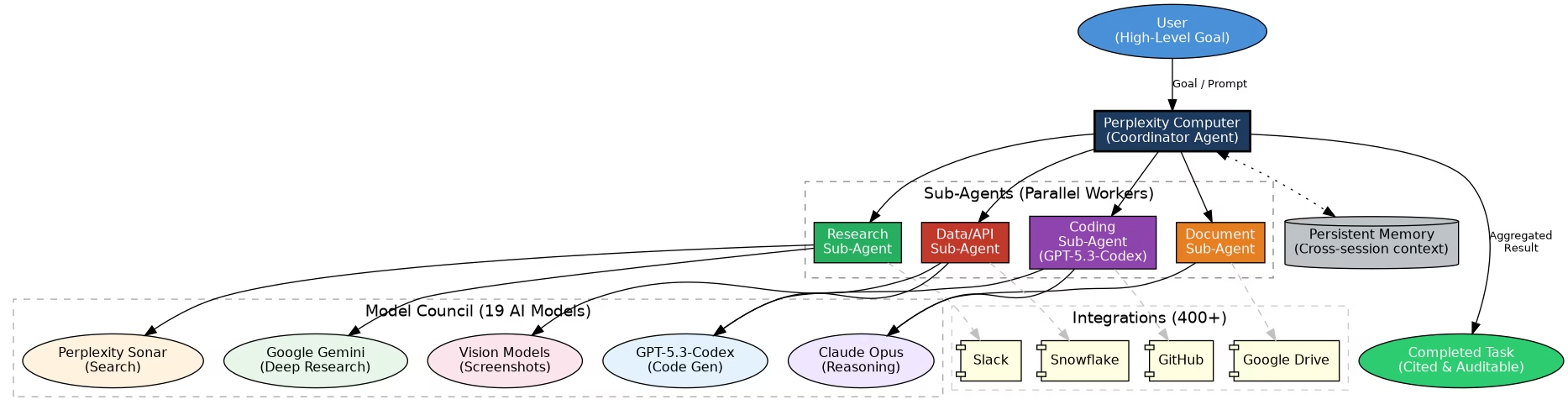
1. The Coordinator Agent
The Perplexity Computer instance itself acts as the top-level orchestrator. It parses your goal, decomposes it into discrete sub-tasks, spins up specialised sub-agents, routes each one to the optimal model, monitors progress, and aggregates the final result. If a sub-agent fails mid-task, the coordinator creates a recovery sub-agent automatically.
2. Sub-Agents
Sub-agents are dynamically created workers assigned to specific narrowly-scoped tasks. They run asynchronously and in parallel — so research, coding, and document generation happen simultaneously. Each sub-agent runs in an isolated compute sandbox with a real filesystem, a real browser (vision-model powered), and full tool integration access.
3. The Model Council (19 AI Models)
The Model Council is Perplexity Computer biggest differentiator — a dynamic routing layer that dispatches sub-tasks to the best available model:
| Task Type | Model Assigned |
|---|---|
| Complex reasoning | Claude Opus |
| Deep research | Google Gemini / Perplexity Sonar |
| Code generation | GPT-5.3-Codex |
| Fast search queries | Sonar (Llama-based) |
| Image interpretation | Vision models |
| Image generation | Veo / proprietary models |
4. Persistent Memory
A cross-session memory layer stores project context, preferences, and prior research. You never re-explain yourself. Custom skills and workflows can be saved and reused across tasks.
5. Computer Use
Perplexity Computer can operate any software — even those without an API — by observing screenshots via vision models and issuing real mouse clicks, keyboard inputs, and scroll events. It navigates dashboards, fills forms, extracts spreadsheet data, and interacts with desktop apps just like a human operator.
Perplexity Computer vs. Other AI Agents
| Feature | Perplexity Computer | ChatGPT | Claude Code | Cursor / Copilot |
|---|---|---|---|---|
| Multi-model routing | ✅ 19 models | ❌ Single | ❌ Claude only | ❌ Limited |
| Real-time web access | ✅ Cited | ✅ Limited | ❌ | ❌ |
| Full workflow execution | ✅ | ❌ | Partial | Code only |
| Computer use | ✅ | ❌ | ❌ | ❌ |
| Cross-session memory | ✅ | ✅ Limited | ❌ | ❌ |
| Enterprise connectors | ✅ Snowflake, Slack | Partial | ❌ | ❌ |
| Auditable citations | ✅ | Partial | ❌ | ❌ |
Cursor and GitHub Copilot are excellent IDE-integrated coding assistants. Perplexity Computer is an autonomous workflow executor. They solve different problems — most engineers who use Perplexity Computer use both.
Real-World Use Cases
For Data Engineers
- Research API docs, scaffold ETL pipeline code, push to GitHub — end to end, one prompt
- Analyse Snowflake query performance and generate dbt model recommendations
- Build pipeline specs from requirements documents without manual copy-pasting between tools
- Monitor data quality dashboards and generate automated incident summaries
For Engineering Teams
- Research docs and libraries, write production code, run tests, create pull request — in one agentic flow
- Debug issues using browser developer tools autonomously
- Generate Architecture Decision Records (ADRs) from conversation history
For Research and Analysis
- Comprehensive market research reports in minutes with full citations
- Competitor analysis with live, real-time web data
- Financial modelling from public data sources
For Enterprise Operations
- Compliance monitoring across jurisdictions
- Sales intelligence: CRM enrichment, personalised outreach generation
- IT workflows: incident triage, runbook execution, status updates
Perplexity Personal Computer and Comet
Perplexity Personal Computer turns a Mac mini into a permanent, always-on local AI agent. It runs 24/7 in the background, monitors local files, and coordinates other AI systems (ChatGPT, Gemini, Grok) for local workflows.
Comet is Perplexity AI-first browser, integrating agentic capabilities directly into browsing. It works as a natural companion to Perplexity Computer for web-heavy research and automation tasks.
Pricing and Availability
- $200/month (Perplexity Max) or $2,000/year
- 10,000 credits included per month — task complexity determines credit consumption
- Default spending cap: $200; can be raised to $2,000
- Tasks pause if credits are exhausted mid-execution
- Initially Max-only; rolling out to Pro and Enterprise users
- Enterprise tier: Snowflake connectors, Slack integration, SSO, CISO-grade security
Limitations Worth Knowing
- Expensive — $200/month is a barrier for individuals and small teams
- Credit drain — complex multi-step tasks consume credits quickly
- Not an IDE replacement — deep in-codebase editing still belongs in Cursor or Copilot
- Still maturing — enterprise rollout ongoing; some features are early access
- Cloud-only — Personal Computer requires Mac mini hardware
Should You Use Perplexity Computer?
If your work involves knowledge-heavy, multi-tool workflows — research, analysis, document creation, cross-platform data tasks — Perplexity Computer is genuinely compelling. The Model Council architecture is smart engineering: routing to the best model per sub-task, rather than forcing one LLM to do everything, is the right design decision.
For data engineers: the Snowflake connector combined with the research-to-code flow is immediately useful. Going from a business requirement to a dbt model pushed to GitHub in a single agentic workflow — with cited sources for every technical decision — meaningfully changes how fast you can move.
The $200/month price point is real. Evaluate it against your team current tooling costs and the time value of the workflows you would automate.
FAQ: Perplexity Computer
What is Perplexity Computer and how is it different from Perplexity AI?
Perplexity AI is a search and answer engine. Perplexity Computer is an autonomous AI agent that takes action — it executes multi-step workflows, operates software, writes and runs code, and integrates with external tools. Where Perplexity AI answers your question, Perplexity Computer does the work.
How does Perplexity Computer coordinate 19 AI models?
A central coordinator agent decomposes your task into sub-tasks and routes each to the most suitable model via the Model Council routing layer. Complex reasoning goes to Claude Opus, code generation to GPT-5.3-Codex, deep research to Google Gemini or Sonar. Routing optimises for accuracy, speed, and cost automatically.
Can Perplexity Computer replace Cursor or GitHub Copilot?
No. Cursor and Copilot excel at in-IDE code editing and codebase navigation. Perplexity Computer excels at end-to-end workflow execution across tools. In practice, engineers use both together for different stages of the same project.
What integrations does Perplexity Computer support?
Over 400 integrations including Slack, GitHub, Google Drive, Snowflake, Salesforce, HubSpot, Datadog, and SharePoint. Enterprise tier adds native connectors for Snowflake and Salesforce with enhanced security controls.
How much does Perplexity Computer cost?
$200/month as part of the Perplexity Max subscription, or $2,000/year. Subscribers receive 10,000 credits per month. Complex tasks consume more credits, with a default spending cap of $200 that can be raised to $2,000.
What is Perplexity Personal Computer?
A software system that turns a Mac mini into a permanent always-on local AI agent. It monitors files and applications, coordinates AI models (ChatGPT, Gemini, Grok) locally, and runs proactive background workflows — essentially Perplexity Computer running on your own hardware.