

Ask an AI chatbot to finish “The dog chased the …” and it may answer “ball.” That small example points to the central idea behind a large language model, or LLM: it uses the text so far to predict what token should come next, then repeats that process to build a response. If you are asking what is an LLM, start with that loop. An LLM is a machine-learning model trained to work with language and generate text from patterns it learned in data. It can sound confident, but it is not checking every sentence against a trusted source.
This lesson follows Level 1, Module 1.1 of the AI Engineering Roadmap. We will keep the explanation practical: what happens during generation, what an LLM is not, why one model can handle many language tasks, and why a plausible answer can still be wrong. You do not need a programming or math background.
What is an LLM?
A large language model is a type of machine-learning model built to process and generate language. “Large” refers broadly to the scale of its training and model, while “language” describes the kind of patterns it works with. The important part for a beginner is not a model’s parameter count. It is the job the model performs when you send a prompt: it uses the text already in context to estimate a likely continuation.
For example, suppose the prompt is: “I put the leftover soup in the …” A model might consider “fridge,” “freezer,” or “container” as possible continuations. It assigns scores or probabilities to possible next tokens, selects one according to its generation settings, adds it to the context, and predicts again. The chosen token becomes part of the input for the next step.
A token is a small piece of text that the model processes. It might be a whole short word, part of a longer word, punctuation, or a space attached to text. We will look at how text gets split into tokens in the next roadmap module. For now, think of a token as one small unit the model can predict.
How next-token prediction becomes a full answer
Text generation is a repeated loop:
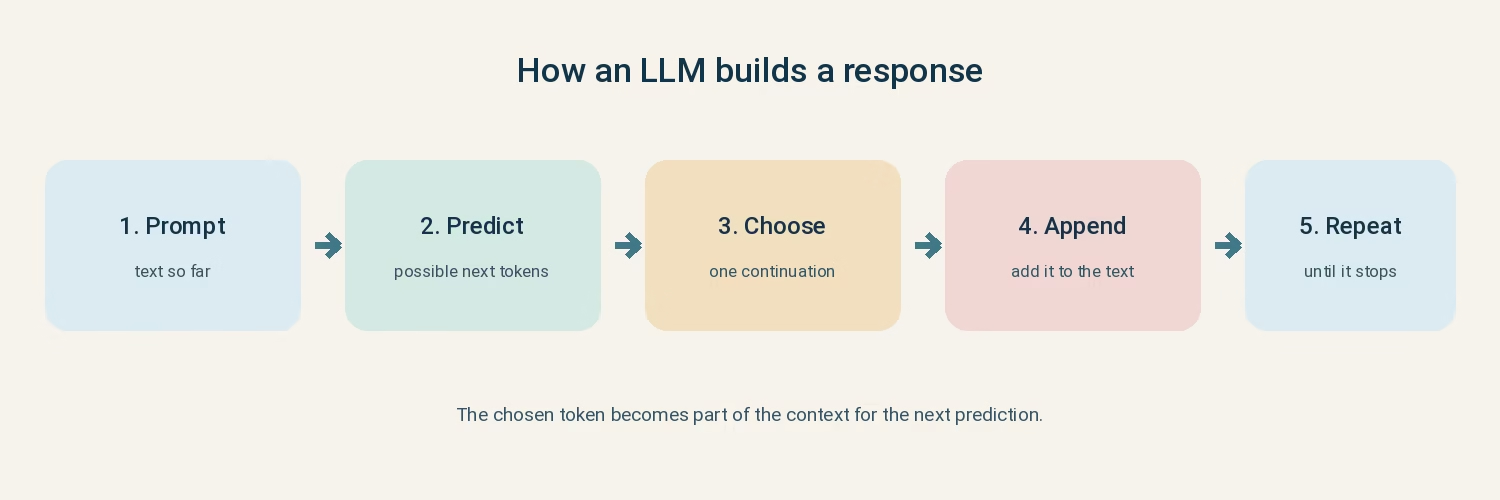
- Read the prompt and conversation so far. The model receives the text in its current context.
- Estimate possible next tokens. It calculates which continuations fit the context and how likely they are.
- Choose a token. The generation method selects one candidate. Depending on settings, the same prompt can lead to different choices.
- Add the token to the text. The model now has a longer sequence to work from.
- Repeat. It keeps going until it reaches a stopping point or output limit.
Here is a simplified example:
Prompt: The little boat crossed the
Possible next tokens: lake, river, bay, street, ...
Chosen token: river

New text: The little boat crossed the river
Next prediction: safely, before, during, ...
This is not a set of fixed fill-in-the-blank answers stored in a list. The model computes a continuation from the current context. “River” is a sensible continuation, but it is not the only one. In a different story, “bay” might fit better.
The roadmap calls this process predict → choose → append → repeat. That phrase is more useful than saying the model “thinks like a person.” It describes what the system is doing without claiming it has human experiences or intentions.
What an LLM is not
Knowing what a model does also means knowing what it does not do automatically. These distinctions prevent common beginner mistakes.
An LLM is not a database
A database stores organized records that can be retrieved by a query. A language model generates a continuation from learned patterns and the current context. It may reproduce familiar facts, but do not assume it has retrieved a verified record whenever it answers a factual question. If an application needs dependable information from a company handbook, for example, it should provide or retrieve the relevant handbook content rather than expect the model to remember the current policy.
An LLM is not a search engine
A search engine looks for pages or documents in an index and points you to them. A plain language model can generate an answer without looking anything up. Some chat products connect a model to web search or other tools, but that is an added capability around the model, not something to assume about every LLM. When freshness or evidence matters, ask for sources and check them.
An LLM is not a deterministic rule-based program
A simple rule-based program follows explicit instructions: if a number is above a limit, return one result; otherwise, return another. A language model is learned from data and generates text by selecting among possible continuations. Even when an application tries to make outputs consistent, variation can happen because of generation settings, model updates, or differences in the prompt and context.
That does not mean LLMs are random in every use or useless for precise tasks. It means you should test the behavior you need instead of assuming that the same prompt is a guaranteed function call with one fixed answer.
Why can one model do many language tasks?
Writing, summarizing, translation, question answering, coding, and classification look like separate jobs to us. They all involve patterns in language, though. A model trained to continue text can learn patterns that help it perform different tasks when the prompt gives it an example or an instruction.
For instance, the request “Translate this sentence into Spanish:” sets up one kind of continuation. “Summarize this paragraph in one sentence:” sets up another. The model uses the same underlying language capability, while the words in the prompt shape the task. This flexibility is one reason LLMs are useful. It is also why the same model can respond in an unexpected way when an instruction is vague or the context is confusing. For a broader learning path, see our AI and machine learning roadmap.
Think of the prompt as a task description, not a magic command. Clear instructions, relevant examples, and useful context make it easier for the model to produce the kind of output you want. They do not guarantee that the result is correct.
Where does an LLM’s capability come from?
The roadmap points to four broad ingredients: data, computing resources, model size, and training. In simple terms, the model learns from examples; training adjusts its internal numerical settings so it gets better at the training task; and more capacity can let a model represent more patterns. These factors work together. Bigger by itself does not mean better for every task, and a model still reflects the limits of its training and design.
You do not need to memorize the training pipeline yet. The next modules explain tokenization, the transformer architecture, and how models learn in more detail. For this first lesson, hold onto a modest claim: an LLM’s output comes from learned statistical patterns applied to the text it currently sees, not from a human-like mind or a guaranteed store of facts.
Why a plausible answer can still be wrong
The model’s immediate goal during generation is to produce a suitable next token, not independently verify each factual claim. A continuation can fit the wording and still contain a mistake. It might also fill a gap with an invented detail if the prompt asks for information it does not have.
That is why fluent writing is not the same as evidence. For a low-stakes task such as brainstorming names, a plausible suggestion may be enough. For medical, legal, financial, or operational decisions, check important claims against reliable sources and have a qualified person review them. If an app needs current or private information, it should connect the model to approved sources and show where its answer came from.
Some systems add retrieval, search, tools, or validation around an LLM. Those systems can improve how information is supplied or checked, but they do not change the basic lesson: inspect the evidence when correctness matters. For an example of a practical system built around an LLM, see our guide to a self-hosted multi-user chatbot.
Try it: predict the next token yourself
Before asking a chatbot, try this short exercise. It takes about two minutes and needs no special software.
- Write the prompt: “For breakfast, I poured milk into my …”
- List three possible next words. There is no single correct answer; “cereal,” “coffee,” and “bowl” can all fit different contexts.
- Ask an LLM to continue the sentence. Note the word or phrase it chooses.
- Change the prompt to add context: “For breakfast, I poured milk over the cereal in my …” Compare the continuation.
- Ask the original prompt again. See whether the response changes.
What changed? The added context gave the model more clues. Repeating the prompt may produce a different continuation, depending on the model and settings. This small activity demonstrates prediction and context; it does not reveal the model’s full internals.
What to learn next
Once the prediction loop makes sense, the next step is to learn what the model predicts. L1/M1.2, “Tokenization,” explains how ordinary text is split into tokens and why a token is not always a whole word. Later modules cover embeddings, attention, transformers, and training. Keeping those lessons separate helps: you can understand the basic behavior before learning the machinery underneath it.
Takeaway: An LLM generates language by repeatedly choosing a likely next token based on the text it has seen so far. That lets one model handle many language tasks, but it does not make the model a search engine, database, or source of guaranteed facts.
Frequently asked questions
What does LLM stand for?
LLM stands for large language model. It is a machine-learning model trained to process and generate language.
Does an LLM predict one word at a time?
Not always one whole word. Models process and generate tokens, which can be whole words, word parts, punctuation, or other text pieces. Tokenization gets its own lesson in the roadmap.
Is an LLM the same as ChatGPT?
No. ChatGPT is a product that uses language models along with an interface and other system components. “LLM” names a type of model, not one specific app.
Can an LLM think or understand like a person?
This lesson does not require a claim about consciousness or human-like understanding. The safe technical description is that the model processes its context and generates text from learned patterns. Whether that counts as “understanding” depends on what someone means by the word, so be precise about the behavior you can observe.
Why does an LLM sometimes make things up?
It generates likely continuations, and a likely-sounding continuation can be false. The model may not have the needed fact in its context, and generation alone is not fact-checking. Verify consequential answers with reliable sources.
Sources and further reading
- AI Engineering Roadmap, Level 1, Module 1.1: What an LLM Actually Is
- Microsoft Learn: LLM fundamentals
- Google Machine Learning Crash Course: Transformers and LLMs
- OpenAI API concepts: tokens and text-generation models
- Vaswani et al., “Attention Is All You Need” (2017)
Ready to continue? Read the next lesson on tokenization and try comparing how an English sentence, code, and a Hindi-English sentence split into tokens.